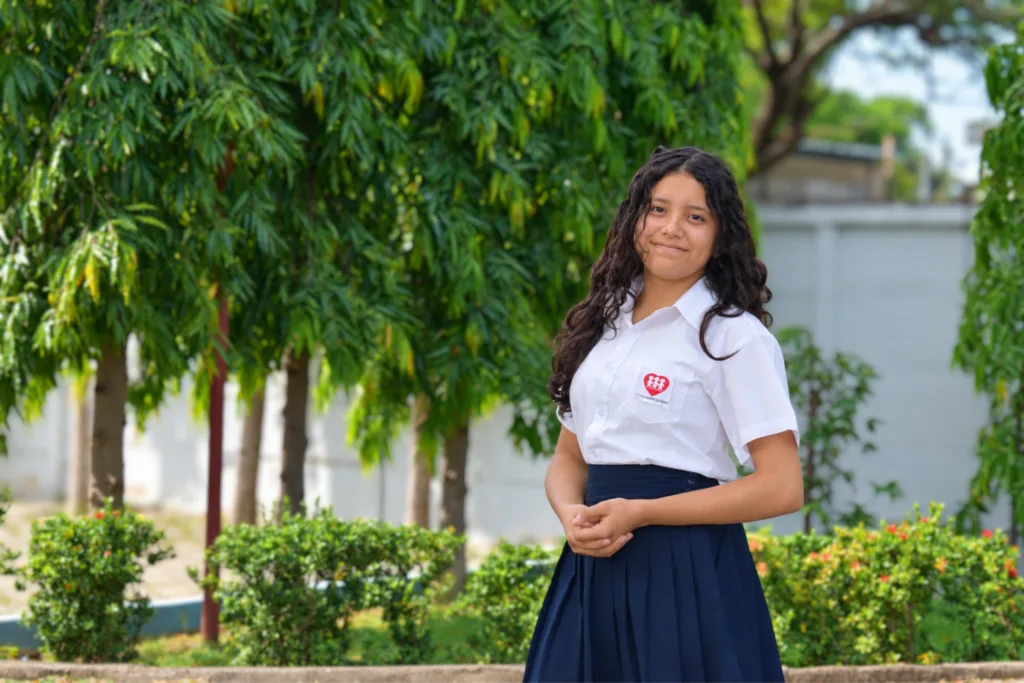
“I used to be the girl who spoke so softly you could barely hear me. Now I know my voice matters.”
Not long ago, Angelina came home from school every day and went straight to her room, closing the door behind her. In class, the young teenager lowered her eyes the moment anyone asked her a question. When she did answer, it was almost in a whisper.
“I was embarrassed to raise my hand,” she remembers. “I was afraid they would laugh at me if I said something ‘dumb,’ and I felt like my voice wasn’t worth anything.”
Today, Angelina laughs out loud. She talks with her classmates and teachers without fear, and she runs home “with my eyes shining,” eager to share what she has learned. That change began in a circle of girls her own age, through La Luz de las Niñas (Light of the Girls), a Fe y Alegría initiative that helps girls build self-esteem, understand their rights, and protect themselves and one another from violence.
For many girls in Nicaragua, violence and rigid gender roles are normalized and often woven into everyday life at home and at school. With support from American Jesuits International (AJI), Fe y Alegría Nicaragua is working to change those norms in urban neighborhoods and rural communities. Through play, art, and Ignatian practices such as mindful breathing, girls learn to name their feelings, recognize risks, and look out for one another.
At the heart of this program are spaces just for girls, where they can explore who they are, what healthy relationships look like, and how responsibilities can be shared at home—moving from “Who am I?” to their families and their wider community.
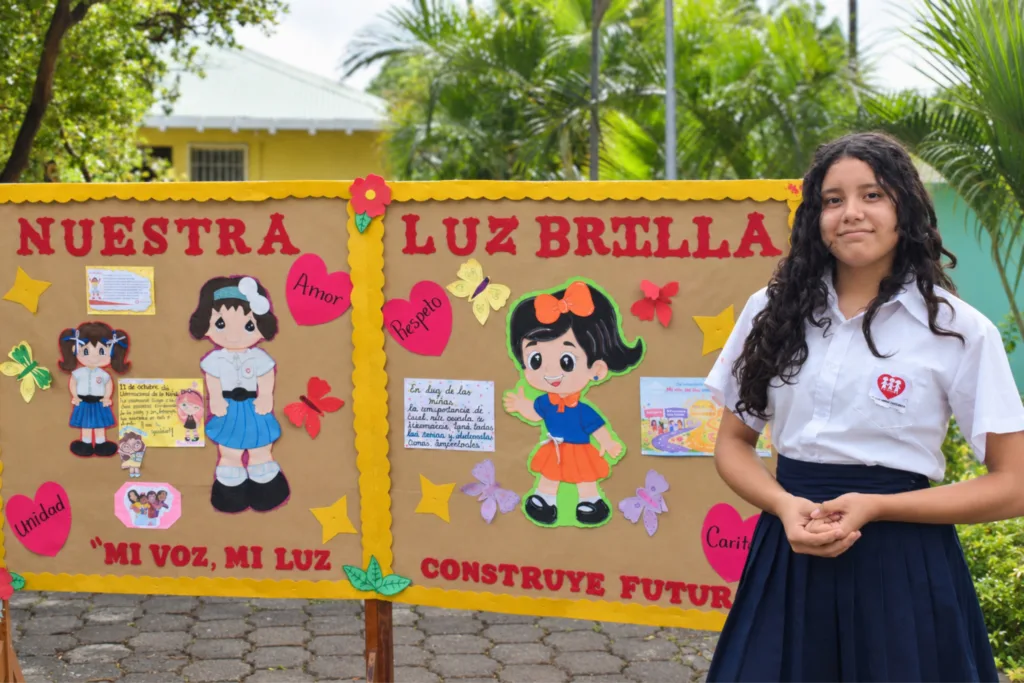
For Angelina, the first sessions were hard. “At the beginning, it was really difficult for me to participate and fit in,” she says. “Many times I just wanted to run away or hide, like I did in my room.”
The facilitators did not push. They made room for her to take small steps. “Little by little, with the accompaniment of the Fe y Alegría staff and the support of the other girls, I started losing that fear,” Angelina says. “I began by speaking softly, then sharing my drawings and my feelings, until one day I found myself speaking loudly in front of everyone without trembling.”
Along the way, she found a phrase she now carries with her. “Every day I tell myself, ‘Be the original. Don’t pretend to be someone else,'” she says. “That makes me feel strong and happy just being me.”
What Angelina learned did not stay at school. One of the sessions invites girls to reflect on how work is shared at home, and she took the lesson straight to her family. “[I’m showing] my dad and mom how to do things differently and even gently correcting them when something isn’t right,” Angelina says. “Thanks to me, there’s no longer any ‘it’s your turn because you’re a woman’: now everyone—my sisters and my parents, too—shares the chores equally because that’s the fair thing to do.”
Her relationships have changed, too. Angelina is the middle child, but she feels like the oldest when she sits down with her sisters to explain how to take care of themselves, how to say “no,” and how to stay safe. With her parents, she now speaks as an equal. “I tell them everything I feel, because now I have the confidence I didn’t have before,” she says. “I’m not the quiet girl I used to be. Now I’m positive, happy, and cheerful, and I fill my house with empathy, respect, and love every day.”
Her story reflects one of the clearest lessons Fe y Alegría Nicaragua has drawn from this program: girls’ empowerment reaches its fullest impact when it becomes shared leadership, when a girl moves from knowing how to protect herself to caring for and standing up for the girls around her. That is exactly where Angelina is headed.
“What I want most now is to keep sharing all of this with other girls,” she says. “I dream that together we can fully live our rights, and that all of us can feel as special and valuable as I feel today.”
Every girl has the right to learn without fear, without limits and without discrimination. When girls like Angelina are accompanied to discover their own worth, the change does not stop with them. It reaches their classrooms, their families, and their communities.