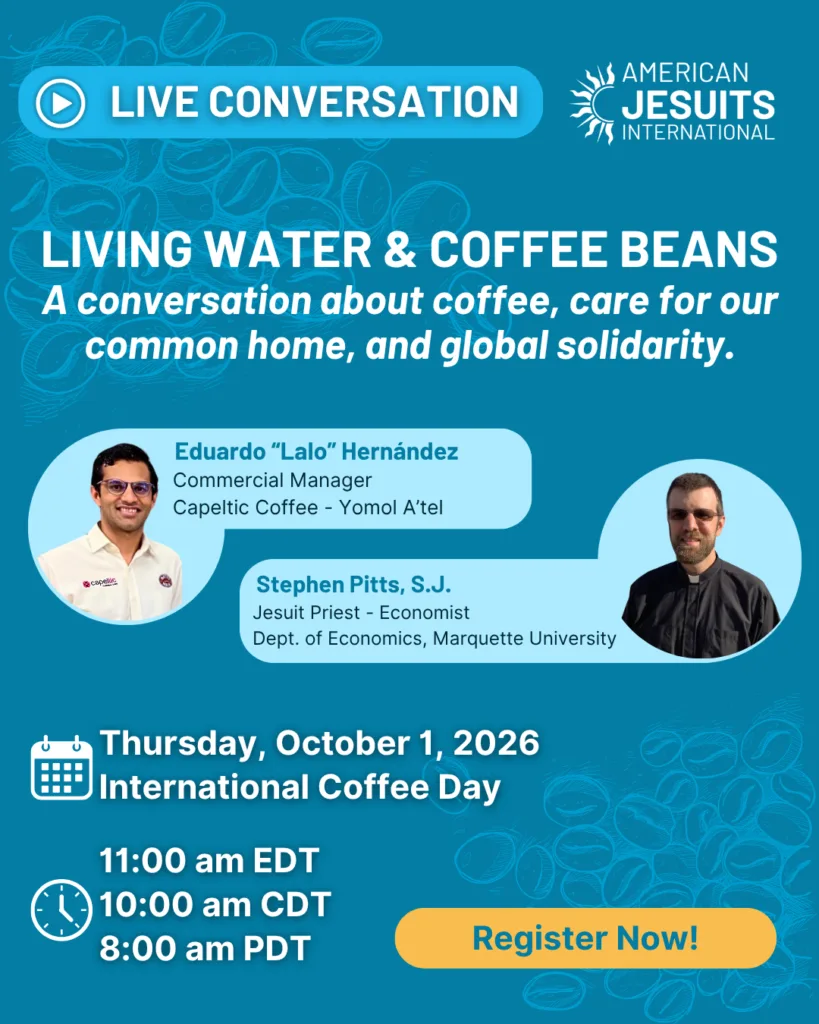
On International Coffee Day, American Jesuits International hosted a live conversation as the Season of Creation drew to a close. This year’s theme, “Living Water,” drew on Ezekiel 47’s vision of a river that grows deeper and brings life to everything it touches. Coffee sits right at that intersection: it takes about 140 liters of water to bring a single cup from the farm to your mug.
Our guests were Eduardo “Lalo” Hernández, Commercial Manager of Capeltic, and Fr. Stephen Pitts, S.J., a Jesuit priest and economist at Marquette University. Capeltic is the coffee brand of Yomol A’tel, a cooperative of Tseltal Maya producers in Chiapas, Mexico, and part of the Comparte Network, a strategic partner of American Jesuits International. Fr. Pitts has studied and worked alongside the project for a decade. More recently, he has expanded his research to include other Jesuit supported cooperatives and social enterprises in Peru and Colombia.
Throughout the conversation, Lalo and Fr. Pitts traced how economic and environmental pressures compound for communities on the margins. The coffee harvest in Chiapas depend on rainfall in a country that has endured drought for a decade. At the same time, most of a farmer’s income arrives in a single harvest season, and prices swing with international markets. Families are betting on an uncertain harvest months and sometimes years in the future so, when shocks hit, large companies barely notice, but small producers feel them dramatically.
In 2012, leaf rust (la roya) wiped out an estimated 80 percent of the harvest, leaving producers without coffee income for years. Lalo explained in our conversation that Yomol A’tel’s response was to build resilience from within. Producers now control the whole value chain, from growing and roasting to five coffee shops of their own, with a stable price for their coffee. They also diversified into honey, which brings income at a different time of year, and the producers’ wives launched handmade soaps and natural cosmetics.
Asked what listeners can do, Fr. Pitts invited us to examine where we spend our money and to treat purchases as ethical decisions. “I don’t think we’re called to do everything, but I think we’re called to do something,” he said. That might mean buying Capeltic coffee or joining a local farm share. Lalo reminded us that “without the consumers, this wouldn’t be possible,” and described the “horizontal relationships” Capeltic hopes to build between producers and the people who drink their coffee.
Watch the full recording above and share it with a fellow coffee lover.
How You Can Take Action
Looking to stay engaged after the talk?